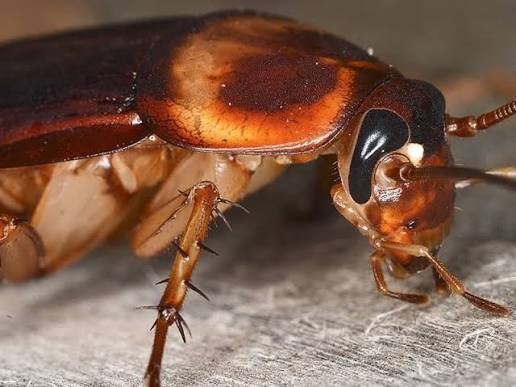
Discover why cockroaches are nearly impossible to crush, drown, or decapitate, and learn how their exoskeletons, spiracles, and nervous systems make them the ultimate biological survivors.
When it comes to raw evolutionary durability, few organisms on Earth rival the cockroach. Having roamed the planet for over 300 million years—surviving mass extinction events, ice ages, and planetary shifts—these ancient insects have adapted to thrive in almost every terrestrial environment on the globe.
To the average homeowner, a cockroach is a reviled pest that seems to defy the laws of biology. They can survive blunt force trauma, hold their breath underwater, thrive on starvation diets, and even scurry around for days without a head.
This resilience is not luck. It is the result of millions of years of specialised biomechanical engineering. By breaking down the intricate internal and external anatomy of a cockroach, we can understand why they are so notoriously difficult to kill—and how to exploit their biological vulnerabilities to eliminate them permanently.
Anatomy of an Insect Survivor: Quick Overview
| Anatomical System | Primary Structure | Evolutionary Superpower | Pest Control Implication |
| Exoskeleton | Chitinous plates & waxy lipid layer | Resists up to 900x body weight; blocks moisture loss | Target with desiccant dusts (boric acid / DE) |
| Respiratory | 10 pairs of lateral spiracles | Can hold breath for 40+ minutes; bypasses head trauma | Surface sprays & bug bombs fail to suffocate. |
| Nervous System | Decentralised ventral nerve cord & ganglia | Retains full motor reflexes without a cephalic brain | Headless survival for up to two weeks |
| Sensory System | Rear abdominal cerci & antennae | Sub-20 millisecond escape reflex via wind detection | Escapes standard swatting; requires passive bait |
| Circulatory | Low-pressure open haemocoel | Clots instantly; zero hydraulic pressure drop | Severed limbs and wounds heal rapidly without fatal bleeding. |
1. The Exoskeleton: Flexible Body Armour and Shock Absorption
The outer shell of a cockroach is a marvel of biomaterials. Unlike vertebrates with internal bone structures, cockroaches encase their vital organs in an external armour constructed from chitin cross-linked with structural proteins (sclerotin).
- Compressible Architecture: A cockroach’s exoskeleton is not a rigid box; it is composed of overlapping plates joined by pliable, elastic membranes. When compressed, these plates slide over one another, redistributing mechanical load evenly across the entire frame. A standard German or American cockroach can withstand mechanical pressures up to 900 times its own body weight without sustaining internal tissue damage.
- Narrow Crevice Navigation: This flexible armour allows cockroaches to flatten their bodies by more than 60%, enabling an adult roach to slip through a gap no thicker than a credit card (roughly 1.6 mm).
- The Epicuticular Lipid Barrier: The outermost layer of the exoskeleton is coated in a microscopic, hydrocarbon wax film. This waxy coating serves as an airtight moisture seal, preventing internal desiccation in dry indoor environments.
2. The Respiratory System: Breathing Through Body Spiracles
Mammals rely on a centralised respiratory system: air enters the mouth and nose, travels down a single trachea, and oxygenates blood through lungs. Cockroaches bypass the head entirely.
- Segmental Spiracles: Along the sides of a cockroach’s thorax and abdomen are 10 pairs of microscopic muscular valves called spiracles.
- Direct Tracheal Network: Each spiracle opens into an intricate network of branching tubes called tracheae and tracheoles, delivering ambient oxygen directly to individual cells through passive diffusion.
- Discontinuous Gas Exchange: Cockroaches can voluntarily clamp their spiracles completely shut to conserve moisture or block out airborne toxins. When submerged in water or exposed to repellent chemical aerosols, a cockroach can close its breathing valves and hold its breath for up to 40 minutes, surviving sewer pipe inundations and temporary toxic gas clouds.
3. The Decentralised Nervous System & The “Decapitation Superpower”
In humans, the brain in the cranium is the central processing unit for all voluntary motion, respiration, and autonomic life support. In cockroaches, neural processing is decentralised along a ventral nerve cord.
- Thoracic and Abdominal Ganglia: Along the length of the cockroach’s belly are independent clusters of nerve cells called ganglia. Each body segment possesses its own dedicated “mini-brain” that processes sensory feedback and commands localised motor actions.
- Autonomous Motor Reflexes: Because leg movement is managed by the thoracic ganglia and breathing is managed by localised spiracles, a decapitated cockroach does not instantly die. The body can stand, climb, and run away when touched.
- The Real Cause of Death: Without mouthparts to drink water, a headless roach eventually succumbs to dehydration after 7 to 14 days.
4. Cerci and Antennae: Advanced Threat Detection
Cockroaches possess an early-warning sensory system that makes hitting them with a rolled-up magazine nearly impossible.
- Rear Sensory Cerci: At the rear tip of the abdomen are two antennae-like appendages called cerci. These structures are covered in hundreds of microscopic, filiform sensory hairs that can detect minute shifts in air currents caused by a predator’s approach (or a human foot descending).
- Giant Interneurons (Sub-20ms Reflex): The cerci connect directly to giant interneurons in the abdominal nerve cord, triggering an automated escape run in less than 15 to 20 milliseconds—long before the sensory signal even reaches the insect’s cephalic brain.
- Compound Eyes & Chemosensory Antennae: Their long, whip-like antennae are packed with thousands of olfactory and gustatory receptors capable of detecting pheromone trails, moisture gradients, and sugar molecules in complete darkness.
5. The Haemocoel: Low-Pressure Open Circulation
Mammals possess a closed circulatory system operating under high hydraulic pressure. A deep puncture wound or severed limb causes rapid haemorrhaging and fatal blood loss within minutes.
Cockroaches have an open circulatory system:
- Bathed in Hemolymph: Cockroaches do not have veins or capillaries. Instead, an open internal cavity called the hemocoel allows insect blood (hemolymph) to freely bathe internal organs.
- The Dorsal Vessel: A simple, multi-chambered tubular heart runs along the insect’s back, gently circulating haemolymph without high pressure.
- Instant Wound Clotting: Because internal pressure is near-zero, severed limbs or puncture wounds do not bleed out. The haemolymph clots almost instantly upon contact with air, sealing the wound and allowing the insect to survive traumatic injuries.
6. The Digestive Tract & Symbiotic Microbes
A cockroach’s digestive tract is built to process almost any form of organic matter:
Symbiotic Endosymbionts: Cockroaches harbour specialised intracellular bacteria (Blattabacterium) inside their fat bodies, along with dense gut protozoa. These microbes produce cellulase to break down cellulose, recycle toxic uric acid waste back into usable amino acids, and allow roaches to extract nutrition from cardboard, book glue, and fabric fibres and shed skin. y conditions where other insects would quickly shrivel and dehydrate.
The Proventriculus (Internal Teeth): Inside the foregut lies the proventriculus, a muscular gizzard lined with hardened chitinous “teeth” that physically grinds tough food particles before they reach the stomach.
The Respiratory System: Breathing Through Spiracles
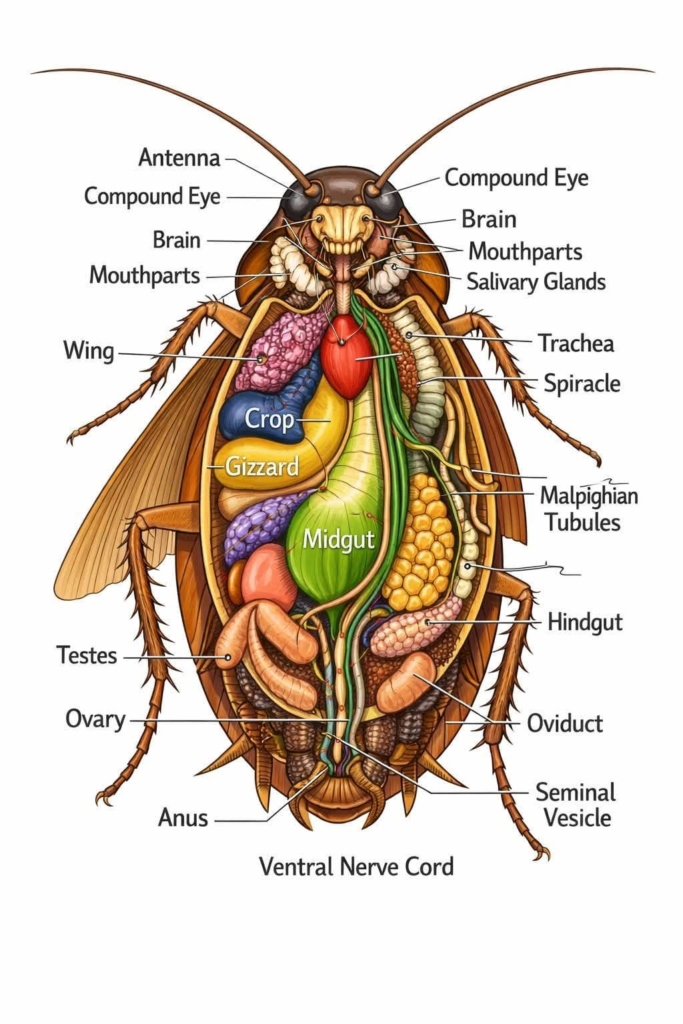
Cockroaches do not possess lungs, nor do they breathe through their mouths. Instead, they take in oxygen through tiny openings lining the sides of their bodies called spiracles.
In environments with low oxygen or high toxicity, a cockroach can actively close these spiracles and hold its breath for up to 40 minutes. This unique adaptation allows them to survive being completely submerged in water or temporarily exposed to airborne insecticidal gases and foggers.
The Decentralised Nervous System
While cockroaches do have a small brain inside their head to process complex information (like finding mates or food), the vast majority of their nervous system runs through their ventral nerve cord—essentially along their belly.
Because of this decentralised setup, basic motor functions and reflexes are controlled locally by these nerve clusters. This means a cockroach can literally lose its head and continue to function. A decapitated roach can still stand, move, and react to stimuli, ultimately dying weeks later only of dehydration because it can no longer drink water.
The Haemocoel (Open Circulatory System)
If a mammal experiences a severe wound, high blood pressure causes rapid blood loss, leading to a quick death. Cockroaches, however, have an open circulatory system operating under very low pressure.
If a cockroach is injured or loses a limb, the wound quickly clots over, preventing any lethal “bleeding out”. This low-pressure system is another major factor in why they survive physical trauma that would instantly kill other animals.
The Digestive Tract & Symbiotic Bacteria
Cockroaches are the ultimate scavengers. While they prefer human food like starches, sweets, and meats, their anatomy allows them to eat almost anything.
The symbiotic bacteria living in their gut allow them to break down cellulose and organic matter that most animals cannot process. Because of this, a cockroach can survive by eating book bindings, cardboard boxes, paper bags, dead skin cells, pet hair, and even certain types of soap.
Conclusion: Turning Biological Strengths into Weaknesses
The cockroach’s anatomical adaptations make it one of the most formidable survival machines in the animal kingdom. Trying to defeat them with blunt force, water submersion, or off-the-shelf aerosol contact sprays plays directly into their evolutionary defences.
To effectively conquer an infestation, you must use their biology against them:
- Target the Epicuticle: Use abrasive desiccant dusts like boric acid or diatomaceous earth, which strip away the waxy lipid layer of their exoskeleton, causing rapid internal dehydration.
- Exploit Grooming Habits: Because roaches obsessively clean their antennae and legs with their mouthparts, non-repellent powders and slow-acting gel baits guarantee lethal ingestion.
- Interrupt Metamorphic Moulting: Deploy Insect Growth Regulators (IGRs) to jam their hormonal cycle, preventing developing nymphs from properly shedding their chitinous exoskeletons.
Frequently Asked Questions (FAQ)
1. Why is it so hard to kill a cockroach by stepping on it?
A cockroach’s flexible exoskeleton is constructed of overlapping chitinous plates linked by elastic membranes that distribute mechanical load evenly across its body. It can absorb shock and withstand pressures up to 900 times its own body weight. Unless you crush it with firm, downward force paired with a twisting/shearing motion, the roach will often absorb the blow and scurry away unharmed.
2. How long can a cockroach survive underwater?
Cockroaches can survive submerged in water for up to 30 to 40 minutes. They accomplish this by tightly clamping shut their lateral breathing valves (spiracles) and entering a state of suspended respiratory metabolism, preventing water from entering their tracheal tubes.
3. Why isn’t cockroach blood red like human blood?
Insect blood (haemolymph) does not contain haemoglobin, the iron-rich protein that transports oxygen and gives human blood its red colour. Because cockroaches deliver oxygen directly to tissues via branching air tubes (tracheae), their hemolymph functions strictly to transport nutrients, hormones, and waste, appearing clear, yellowish, or slightly pale amber.
4. Can cockroaches regrow lost legs or antennae?
Yes, but only during the juvenile nymph stage. If a growing nymph loses a leg or antenna to a predator or physical trauma, it can regenerate the lost limb across successive moulting cycles (ecdysis). Once a cockroach completes its final moult into an adult, it can no longer shed its skin and loses the ability to regenerate lost appendages.
5. Why do cockroaches constantly clean and groom their antennae?
A cockroach’s antennae are its primary sensory organs, covered in thousands of microscopic chemoreceptors that detect food scents, moisture, and danger pheromones. If dust, grease, or dirt accumulates on them, the insect is effectively blinded. Cockroaches constantly pull their antennae through their mouthparts to keep them clean—a compulsive behaviour that ensures they ingest slow-acting insecticidal dusts like boric acid.
6. How do cerci help cockroaches escape danger so quickly?
The cerci are two sensory appendages protruding from the rear of the abdomen, equipped with sensitive hairs that detect micro-disturbances in surrounding air currents. When a downward air wave (such as a swatting hand or descending shoe) is detected, the cerci send a direct nerve impulse straight to the leg muscles via giant interneurons, triggering a reflex escape run in under 20 milliseconds.
7. How does boric acid destroy a cockroach’s anatomy?
Boric acid works through a devastating two-part attack:
- Externally: The sharp, abrasive micro-crystals scrape away the waxy protective lipid coating of the exoskeleton, causing moisture to rapidly evaporate.
- Internally: When the roach grooms its legs and antennae, it ingests the powder. The boric acid acts as an aggressive stomach poison, destroying the lining of its digestive tract and fatally disrupting its metabolic nervous system.


