Discover the biological reason cockroaches die on their backs indoors, how neurotoxin insecticides cause muscle spasms, and why smooth floors trap them.
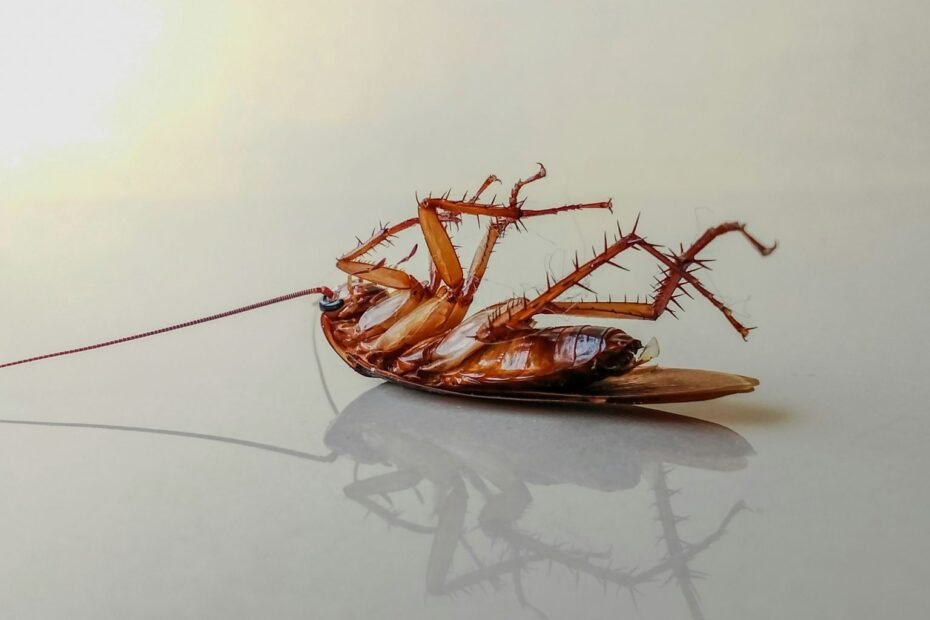
It is one of the most universal images in pest control: a dead cockroach lying motionless on its back with its legs curled toward the ceiling.
Why Do Cockroaches Die on Their Backs? The Biological Reason
Whether in cartoons, bug spray commercials, or under your own kitchen cabinets, this inverted posture is the iconic “dead bug pose.” But why does this happen so consistently? Is it random chance, or is there a specific physiological and environmental reason roaches end up upside down in their final moments?
The answer lies at the intersection of insect anatomy, neurotoxic chemistry, and the man-made physics of modern indoor flooring.
1. Top-Heavy Anatomy: A High Center of Gravity
The primary physical reason a dying cockroach flips over is its anatomical structure:
- Heavy Dorsal Armor: A cockroach’s body mass is concentrated on top. It possesses a thick, protective dorsal exoskeleton, dense wing covers (tegmina), and a heavy shield-like pronotum behind its head.
- Long, Spindly Legs: In contrast to its bulky upper body, its six legs are long, thin, and positioned entirely on the ventral (underside) surface.
- Tension and Balance: In a healthy, living cockroach, constant muscular tone and neuromuscular control maintain a low, stable center of gravity, allowing it to sprint across walls and ceilings effortlessly.
When a cockroach becomes sick, aged, or poisoned, it loses the muscular control required to keep its spindly legs positioned beneath its heavy frame. As the legs buckle and give out, the insect’s high center of gravity naturally rolls its rounded body onto its back.
2. How Neurotoxin Insecticides Trigger the Flip
Most commercially available roach sprays and extermination chemicals rely on neurotoxins—primarily synthetic pyrethroids, organophosphates, or neonicotinoids.
These chemicals do not cause an instant, graceful death. Instead, they disrupt the insect’s nervous system:
- Sodium Channel Disruption: Pyrethroids prevent nerve cells from closing their sodium channels, resulting in continuous, repetitive electrical firing.
- Violent Spasms: The roach suffers massive, uncontrollable muscle spasms, tremors, and total loss of motor coordination.
- The Roll: As its six legs kick erratically and out of sync, the roach stumbles, loses its footing, and violently pitches onto its rounded back.
3. The Indoor Flooring Dilemma: Smooth Tile vs. Natural Forest Litter
You rarely find wild cockroaches dead on their backs in natural forest environments. The upside-down death is largely an indoor phenomenon caused by modern human architecture.
| Environment | Surface Texture | Available Leverage | Survival Outcome When Flipped |
| Outdoors (Wild) | Rough soil, leaves, twigs, bark | High (abundant debris to grab) | Roach easily rights itself; dies right-side up or is eaten by predators. |
| Indoors (Homes) | Polished tile, linoleum, hardwood, laminate | Near Zero (slick, frictionless surfaces) | Flipped roach kicks air, exhausts energy, and remains stuck. |
In nature, if a wild roach rolls over, its spiny legs can readily grab onto leaves, grass stems, bark, or uneven soil to pull itself upright.
Indoors, our smooth, polished surfaces offer zero mechanical leverage. Once an uncoordinated or dying roach lands on its slick, rounded back on polished kitchen tile, it has nothing to grip. It kicks helplessly at empty air until its energy reserves are exhausted.
4. Failure of the “Righting Reflex”
Healthy cockroaches possess a built-in biomechanical maneuver called the righting reflex:
- When an active, healthy roach is flipped upside down, it uses a combination of wing flutter and a powerful push from its long rear legs to catapult its body over.
- Alternatively, it will arch its abdomen, tuck one side of its legs under its carapace, and lever itself back onto its feet.
A dying, dehydrated, or poisoned cockroach lacks the muscular strength, energy, and neurological synchronization required to execute this maneuver. Each failed attempt drains its remaining strength, leaving it permanently inverted.
5. Why Do Their Legs Curl Inward?
In addition to being upside down, dead roaches almost always have their legs tightly curled inward toward their chest.
This occurs due to post-mortem physiological changes:
- Loss of Hemolymph Pressure: An insect extends its limbs using internal fluid pressure (hemolymph). When the roach dies, internal pressure drops completely.
- Tendon Contraction: Without active blood pressure and nerve impulses holding the legs extended, the elastic flexor tendons naturally contract, pulling the legs tightly inward into a curled, defensive-looking posture.
Conclusion: A Perfect Storm of Anatomy and Physics
A cockroach dying on its back is not an intentional behavior or a defensive reflex. It is the natural consequence of a top-heavy insect losing its neurological control on an unnaturally smooth indoor floor.
When nerve toxins destroy its coordination, the roach’s legs buckle, its heavy upper shell rolls it onto its back, and polished modern flooring prevents it from regaining traction. The iconic “dead bug pose” is simply the final resting state of an insect designed for the rough textures of nature, trapped in a human environment it cannot navigate.
Frequently Asked Questions (FAQ)
1. Do cockroaches ever die right-side up?
Yes. In natural outdoor habitats—such as forests, compost piles, and leaf litter—cockroaches frequently die right-side up. Abundant twigs, soil textures, and leaves allow them to right themselves if they roll over. Furthermore, wild roaches are usually eaten by predators (birds, spiders, rodents) long before they die of old age on their backs.
2. Can a healthy cockroach flip itself back over if it lands on its back?
Yes. A healthy, uninjured cockroach can right itself within fractions of a second. It uses its long hind legs and wing covers to lever or roll its body back onto its feet, even on relatively smooth surfaces.
3. How long can a cockroach survive upside down on its back?
A healthy cockroach accidentally stuck upside down on an ultra-smooth surface (like the bottom of a glass jar) can survive for several days until it succumbs to dehydration. A roach that is upside down due to insecticide poisoning will typically die within several hours to 24 hours.
4. Do cockroaches “play dead” on their backs to trick humans?
No. Cockroaches do not practice thanatosis (feigning death) on their backs. If you see a roach lying on its back, it is either actively dying from insecticide/illness, severely dehydrated, or too exhausted to right itself. However, if touched or nudged, a lingering surge of reflex adrenaline may cause it to briefly scurry away.
5. Why do roaches die on their backs even when no insecticide was used?
Old age, severe dehydration, and starvation produce the same physical outcome. As a cockroach nears the end of its natural lifespan, its nervous system degrades and its leg muscles weaken. It eventually loses the strength to support its top-heavy frame, flips over, and cannot generate enough force to right itself.
6. Why are dead roaches usually found in the middle of open rooms?
When a cockroach is exposed to lethal neurotoxins, the resulting hyperactivity and disorientation disrupt its normal light-aversion instincts (negative phototaxis). In its disoriented state, it wanders out of its dark harborages into open floor spaces where it finally collapses.
7. What should I do if I find an upside-down cockroach in my home?
Always treat an upside-down roach as a signal of pest activity:
If you did not apply pesticides recently, finding an upside-down roach may mean it came into contact with a neighbor’s treatment or is dying of an established colony infestation that requires targeted baiting.
Remove and dispose of the insect using a paper towel or vacuum (avoid bare hands, as roaches carry bacteria).
Inspect nearby dark harborages (under the sink, behind appliances).


