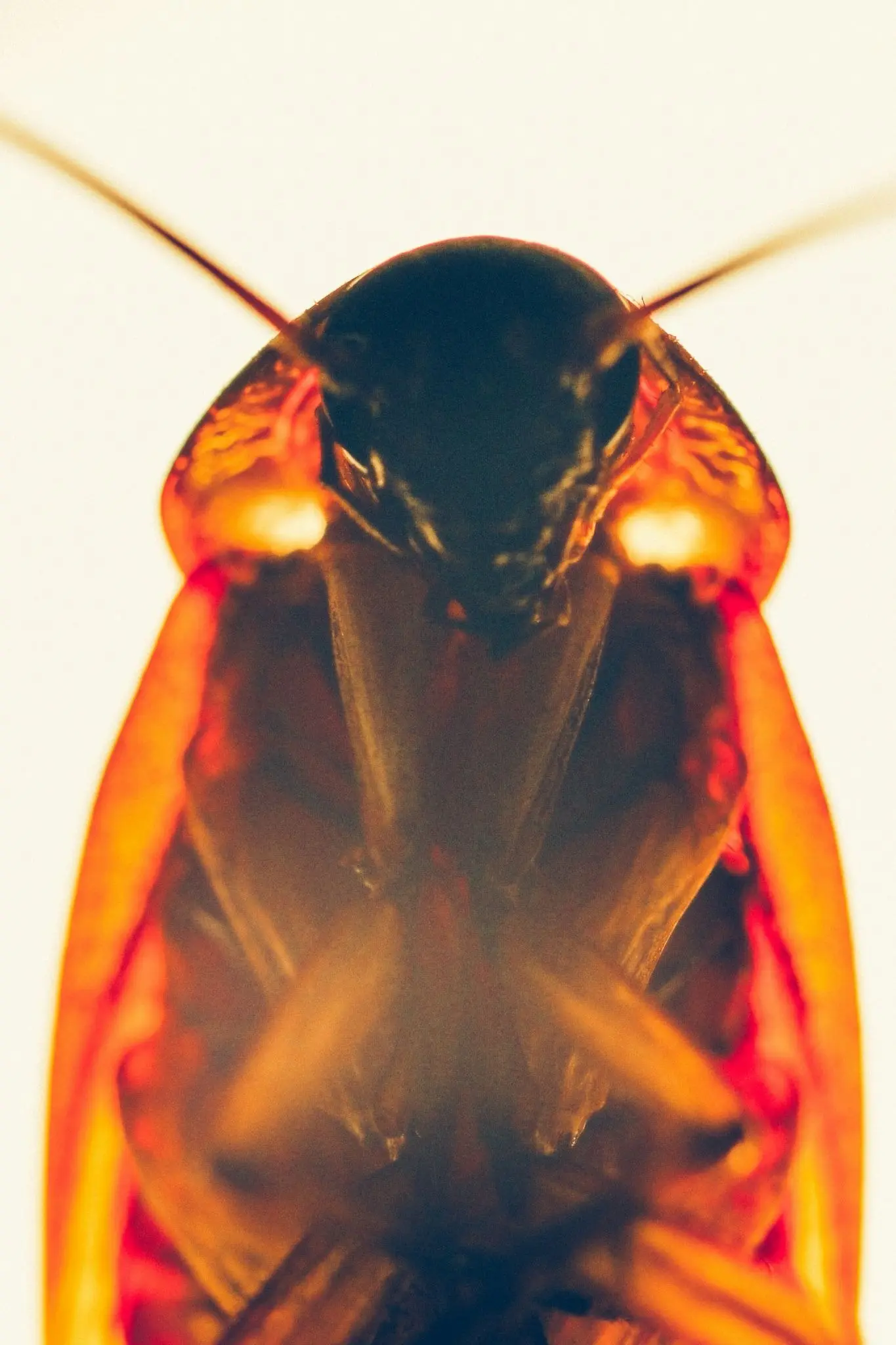
Can you tell how old a cockroach is? Learn how to determine a roach’s age and life stage by its size, color, and wing growth—and what it reveals about an infestation.
How to Tell the Age of a Cockroach: Life Stages, Instars, and Infestation Timelines
When an unexpected roach darts across your floor, your immediate focus is usually on squashing it. However, taking a closer look at the insect before disposing of it provides critical intelligence. Determining the age and maturity level of a cockroach reveals whether you are dealing with a lone outdoor wanderer or an active, expanding breeding colony tucked behind your kitchen walls.
Cockroaches undergo incomplete metamorphosis (hemimetabolous development), meaning they do not transform through a caterpillar-to-chrysalis phase. Instead, they hatch as miniature versions of adults and progress through distinct growth stages called instars.
Here is how to read physical markers to determine a cockroach’s approximate age, stage of life, and what its presence means for your living space.
The 4 Life Stages: How to Determine a Cockroach’s Age
| Life Stage | Approximate Age | Physical Markers | Wings & Mobility |
|---|---|---|---|
| 1. Egg (Ootheca) | Day 0 – 6 weeks | 5–9 mm pill-shaped capsule | Stationary |
| 2. Early Nymph | 1 – 30 days old | 1–3 mm (rice-sized), lighter coloration | Completely wingless |
| 3. Late Nymph | 1 – 4 months old | 4–12 mm, darkened exoskeleton | Wing pads visible, no functional wings |
| 4. Mature Adult | 2 – 24 months old | Full adult size and coloration | Fully developed, functional wings |
1. The Egg Stage (Ootheca)
- Age: Day 0 to 6 weeks (species- and temperature-dependent).
- Appearance: A hard, purse-shaped, or pill-shaped protective capsule containing 14 to 50 developing embryos.
- Identifying Features: An unhatched ootheca is plump, glossy, and ranges from light amber to dark mahogany. Once hatched, the capsule features a split seam down the center and appears hollow.
- Infestation Meaning: If you spot an attached ootheca on a live German female, hatching is imminent. If you find detached, empty casings behind baseboards, a new generation is already foraging in your home.
2. Early-Stage Nymphs (Instars 1 to 3)
- Age: 1 to 30 days old.
- Appearance: Tiny, measuring between 1 and 3 mm (roughly the size of a grain of sand or a speck of ground pepper).
- Identifying Features: Early nymphs are completely wingless. German cockroach nymphs feature a dark brown body with a pale tan spot in the center of their back. Immediately following a molt, they appear pure white for several hours before their new exoskeleton oxidizes and darkens.
- Infestation Meaning: Very young nymphs do not travel far from their harborage. Finding them indicates an active hatching site within a 2- to 3-foot radius—typically in appliance motor cavities, cabinet hinges, or plumbing gaps.
3. Late-Stage Nymphs (Instars 4 to 7)
- Age: 1 to 4 months old.
- Appearance: Intermediate size, typically ranging from 4 mm to over 12 mm depending on the species.
- Identifying Features: As nymphs approach maturity, they molt through multiple instar stages (typically 5 to 7 times). You will begin to notice tiny, raised “wing pads” on their thorax, though they still lack functional wings. Their outer coloration darkens significantly, matching the hue of mature adults.
- Infestation Meaning: A population dominated by mid- to late-stage nymphs indicates a sustained, thriving infestation that has been multiplying unhindered for months.

4. Mature Adults
- Age: 2 months to 2 years old (German roaches live roughly 100 to 200 days, while American roaches can survive up to 2 years).
- Appearance: Full adult size (half an inch for German roaches; up to 2 inches for American roaches).
- Identifying Features: Adults possess fully formed, overlapping wings that extend to or past the tip of the abdomen. They are sexually mature and capable of rapid reproduction.
- Infestation Meaning: Seeing mature adults during daytime hours indicates severe harborage overcrowding, forcing dominant roaches out into the open to forage.
How Entomologists Accurately Estimate a Roach’s Age
While you cannot count “growth rings” on an insect, professional entomologists use three primary anatomical markers to determine a cockroach’s developmental age:
- Wing Pad Progression: Juvenile nymphs have smooth, segmented thoracic plates. As they pass each molt, small, triangular wing pads emerge and lengthen. Once overlapping, functional wings are present, the insect is in its final adult stage.
- Antennal Segment Count: Every time a nymph molts into a successive instar, additional segments (flagellomeres) are added to its antennae, making them longer and more sensitive to chemical pheromones.
- Exoskeleton Wear & Tearing: Very old adult cockroaches frequently exhibit physical wear. They may have tattered wing tips, missing legs or leg spines, broken antennal segments, and a duller, chipped outer shell.
The Evolutionary Age: 300+ Million Years Old
When people ask about the “age of cockroaches,” they are often referring not to a single bug, but to the age of the species itself.

Cockroaches are among the oldest winged insects on the planet. Ancestral roach-like insects known as roachoids first appeared in the fossil record during the Carboniferous period, approximately 320 to 350 million years ago.
- Older Than Dinosaurs: Cockroaches walked the Earth over 100 million years before the first dinosaur evolved.
- Surviving Cataclysms: They lived through the Permian-Triassic extinction (which eliminated over 90% of all life) as well as the Cretaceous-Paleogene asteroid impact that wiped out the dinosaurs.
- Evolutionary Perfection: Modern cockroaches look remarkably similar to their fossilized ancestors preserved in ancient amber, proving that their physical blueprint—decentralized nervous systems, flexible exoskeletons, and omnivorous scavenging—was biologically optimized hundreds of millions of years ago.
Why Roach Age Matters for Extermination
Understanding insect age determines the type of treatment required:
- If you see only early nymphs: The source nest has hatched right next to where you spotted them. Focus your gel baits and light dustings of boric acid in the immediate vicinity.
- If you see mostly late nymphs: A continuous cycle is established. You must deploy an Insect Growth Regulator (IGR). IGRs flood the juvenile roaches with synthetic hormones, disrupting their molting cycle and causing them to develop crumpled wings and sterile reproductive organs, effectively ending the colony’s breeding lineage.
- If you see a solitary large adult: Inspect exterior entry points, door sweeps, and window screens. A single large American or wood roach is frequently an outdoor invader rather than an established indoor colony.
Final Verdict: Read the Bug to Clear the Nest
A cockroach’s age tells a clear story. While finding an adult cockroach can sometimes be an isolated incident of a wanderer seeking moisture, discovering tiny, wingless nymphs is definitive proof that a nest is breeding nearby. By inspecting size, coloration, and wing development, you can pinpoint where the infestation stands on the developmental timeline and apply targeted gel baits and insect growth regulators to shut down the breeding cycle permanently.
Frequently Asked Questions (FAQs)
1. How can I tell if a cockroach is a baby or an adult?
The easiest indicator is the presence of wings. Adult cockroaches have fully formed, overlapping wings that cover their back. Cockroach nymphs (babies) are completely wingless or display only small, immature wing pads. Nymphs are also significantly smaller and often lighter in color.
2. How long does it take for a cockroach egg to become an adult?
Development speed depends heavily on temperature and species. A German cockroach can complete the journey from egg to mature adult in roughly 60 to 100 days under warm indoor conditions. Larger species, such as the American cockroach, take considerably longer—often requiring 6 to 12 months (or more) to reach adulthood.
3. How long do cockroaches live once they reach adulthood?
Adult lifespan varies by species. An adult German cockroach typically lives for 100 to 200 days, during which a female can produce multiple egg cases. An adult American cockroach can live for roughly one to two years under favorable conditions with adequate food and water.
4. What does finding tiny baby roaches in the kitchen mean?
Finding early-instar nymphs (the size of a pinhead or rice grain) indicates that an egg capsule (ootheca) has recently hatched inside your home. Because young nymphs cannot travel far, the breeding nest is almost certainly hidden within a few feet of the sighting.
5. Can you tell a cockroach’s age by its size alone?
Size is helpful within a specific species, but it can be misleading if you do not know which species you have. For example, a fully grown, mature German cockroach measures roughly half an inch—which is the exact same size as a mid-stage juvenile American cockroach nymph. Always check for functional wings to confirm whether it is a small adult or a growing nymph.
6. Do cockroaches die of old age?
In domestic environments, cockroaches rarely die strictly of old age; they usually fall victim to dehydration, predators, baits, or chemical insecticides. However, laboratory specimens that reach old age exhibit reduced motility, ragged wing edges, lost appendages, and sluggish grooming habits before dying naturally.
7. How old is the cockroach species compared to humans?
Cockroaches as a biological group are vastly older than human beings. Primitive roach ancestors originated over 300 million years ago during the Carboniferous period. By comparison, anatomically modern humans (Homo sapiens) have only existed for roughly 300,000 years.