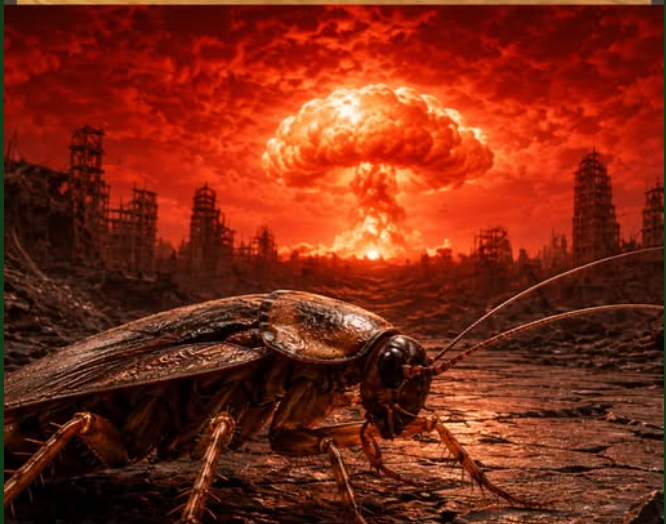
Explore the science behind whether cockroaches can survive a nuclear apocalypse, how radiation affects their cells, and what real-world experiments reveal about their true biological limits.
In popular culture, the end of the world is almost always depicted with two permanent survivors: Twinkies and cockroaches.
From post-apocalyptic video games to disaster blockbusters, the idea that cockroaches would easily inherit a radioactive wasteland after a global nuclear war has become common lore. But how much of this reputation is backed by hard science, and how much is urban legend fuelled by our collective frustration with how difficult they are to kill?
While cockroaches are significantly more resistant to ionising radiation than humans, the idea that they are completely immune to nuclear devastation is a mix of biological truth and exaggerated science fiction.
The Origins of the Myth: Hiroshima and Nagasaki
The belief that cockroaches can shrug off a nuclear bomb began in the aftermath of World War II. Following the atomic detonations over Hiroshima and Nagasaki in 1945, early recovery teams and journalists reported seeing cockroaches scurrying through the irradiated rubble and surviving in areas where nearly all other animal life had been destroyed.
These initial observations quickly evolved into the myth of the “indestructible roach”.
However, context matters: many of these insects were shielded beneath heavy concrete slabs, deep underground in soil crevices, or sheltered inside drainage systems that deflected the immediate thermal heat wave and direct initial radiation burst.
Testing the Legend: The Science of Radiation Tolerance
To determine whether cockroaches could actually survive high-dose radiation, entomologists and researchers—including the team on the Discovery Channel’s MythBusters—subjected German cockroaches (Blattella germanica) to controlled doses of Cobalt-60 radiation.
The experimental findings clearly define the biological limits of the insect:
| Organism | Lethal Dose (LD50 / LD100) | Survival Outcome |
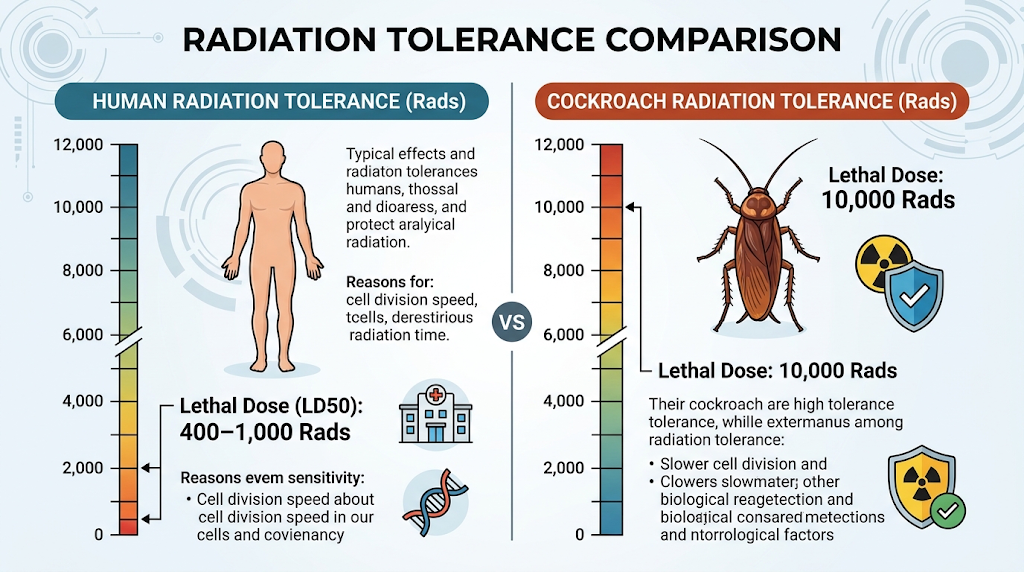
| Humans | 400 to 1,000 rads (4–10 Gy) | 50% to 100% mortality without immediate intensive medical intervention. |
| German Cockroach | 1,000 rads (10 Gy) | 100% Survival: No noticeable change in vitality or lifespan. |
| German Cockroach | 10,000 rads (100 Gy) | ~10% Survival: Significant mortality, but roughly one in ten survived 30 days. |
| German Cockroach | 100,000 rads (1,000 Gy) | 0% Survival: 100% lethal within hours; complete cellular breakdown. |
While a cockroach can tolerate roughly 6 to 15 times the radiation dose that would kill a human, they are far from invincible. At extreme radiation levels, their vital systems fail just like any other living organism.
The Biology: Why Roaches Resist Radiation Better Than Humans
The secret to a cockroach’s radiation tolerance comes down to basic cellular biology and the Law of Bergonié and Tribondeau—a fundamental rule of radiation physics stating that cells are most vulnerable to radiation damage when they are actively dividing.
1. Infrequent Cell Division (Ecdysis)
Human cells are in a constant state of rapid division. Our bone marrow continuously generates red and white blood cells, our gastrointestinal lining regenerates every few days, and our skin renews itself around the clock. When ionising radiation strikes actively dividing human cells, it shatters DNA strands during mitosis, leading to rapid tissue death and immune failure.
Cockroaches, by contrast, only experience bursts of rapid cell division during moulting cycles (ecdysis) as juveniles. Once an adult roach completes its final moult, its non-reproductive cells rarely divide. Because their cells are metabolically stable and static, radiation passes through their bodies with a significantly lower probability of causing fatal, systemic DNA fragmentation.
2. High-Efficiency DNA Repair Enzymes
In addition to slow cell division, insects possess robust, highly active enzymatic DNA repair mechanisms. Minor chromosomal lesions and single-strand breaks caused by ambient radiation can be repaired before they cause systemic organ collapse.
The Ultimate Nuclear Reality: Blast vs. Fallout
Surviving radiation fallout is only one factor in a nuclear explosion. In a true nuclear event, a cockroach faces several unavoidable physical threats:
- The Thermal Heat Wave: A nuclear detonation generates ground-level temperatures exceeding several thousand degrees Celsius. Any cockroach caught within the immediate thermal blast radius is instantly vaporised.
- The Overpressure Shockwave: While a cockroach’s flexible exoskeleton can withstand significant atmospheric pressure changes, the physical collapse of structures, flying debris, and extreme kinetic displacement within the blast zone will crush them.
- Nuclear Winter: Cockroaches are ectothermic (cold-blooded) organisms that rely entirely on ambient heat to maintain metabolic function. A global “nuclear winter”—characterised by prolonged sub-freezing temperatures and dense cloud cover blocking sunlight—would prove lethal to indoor-adapted roaches like the German cockroach within weeks.
The Real Champions: Insects That Outsurvive the Roach
Contrary to popular belief, the cockroach is not even close to being the most radiation-resistant insect on Earth. Several other species dramatically outperform them:
Microbial Extremophiles: Microscopic organisms like the bacterium Deinococcus radiodurans can withstand upwards of 1,500,000 rads without losing viability.
The Common Fruit Fly (Drosophila melanogaster): Can survive radiation exposures exceeding 64,000 rads.
The Red Flour Beetle (Tribolium castaneum): Routinely survives doses up to 100,000 rads.
The Parasitic Wasp (Habrobracon hebetor): The undisputed insect champion, capable of surviving an astounding 180,000 rads—nearly 200 times the lethal human dose.
Conclusion: Tougher Than Humans, But Not Invincible
The idea that cockroaches will effortlessly rule a post-nuclear world is largely a myth.
While their slow cellular division cycles and durable biology grant them roughly 10 to 15 times the radiation tolerance of a human, they are completely vulnerable to the extreme heat, physical shockwaves, and deep freezes of a nuclear event.
Cockroaches are master survivors of the natural world, but in the face of an apocalyptic event, they would fall alongside most other complex life forms—leaving the real crown to microscopic bacteria and parasitic wasps.
Frequently Asked Questions (FAQ)
1. How much radiation can a cockroach survive compared to a human?
A human will typically receive a lethal dose of radiation at 400 to 1,000 rads (4 to 10 Grey). A German cockroach can survive exposures of 1,000 rads with zero impact on lifespan, and roughly 10% of a population can survive doses up to 10,000 rads. However, at 100,000 rads, all cockroaches perish.
2. Would cockroaches survive the initial blast of a nuclear detonation?
No. The immediate thermal pulse of a nuclear explosion produces temperatures hotter than the surface of the sun, vaporising all organic matter in the immediate vicinity. Cockroaches only survive if they are far enough from the hypocentre or deep underground in reinforced structural shelters.
3. Which insect is actually the most radiation-resistant?
The Habrobracon parasitic wasp (Habrobracon hebetor) is one of the most radiation-resistant insects known, surviving doses up to 180,000 rads. The flour beetle (Tribolium) and fruit fly (Drosophila) also exhibit significantly higher radiation resistance than cockroaches.
4. Can radiation cause cockroaches to mutate into giant pests?
No. High-dose radiation causes cellular degradation, reproductive sterility, and lethal DNA mutation—it does not create giant organisms. Furthermore, cockroach size is physically limited by their respiratory system; because they rely on passive diffusion through spiracles and tracheae, atmospheric oxygen levels strictly cap how large an insect can grow.
5. How would a “nuclear winter” affect cockroaches?
A nuclear winter would be catastrophic for domestic cockroaches. Common household species like the German and brown-banded cockroach require ambient temperatures between 70°F and 85°F (21°C to 29°C) to thrive. Extended freezing temperatures would quickly kill them, as they lack the antifreeze compounds present in specialised arctic insects.
6. Can cockroaches reproduce after being exposed to high radiation?
While adult cockroaches may physically survive radiation doses around 10,000 rads, the exposure frequently renders them completely sterile. Ionising radiation damages the rapidly dividing cells in their reproductive organs and destroys the viability of egg capsules (oothecae), halting future generations.
7. Why were live cockroaches found in Hiroshima after the bombing?
Cockroaches found alive after the bombing were protected from direct thermal radiation and ionising rays by hiding deep inside concrete basements, thick foundations, drainage pipes, and sewer tunnels. Their natural habit of sheltering in subterranean micro-crevices provided accidental shielding against the weapon’s effects.


