Explore the largest cockroaches on Earth, including Megaloblatta longipennis, the Australian Giant Burrowing Cockroach, and the Giant Cave Cockroach.
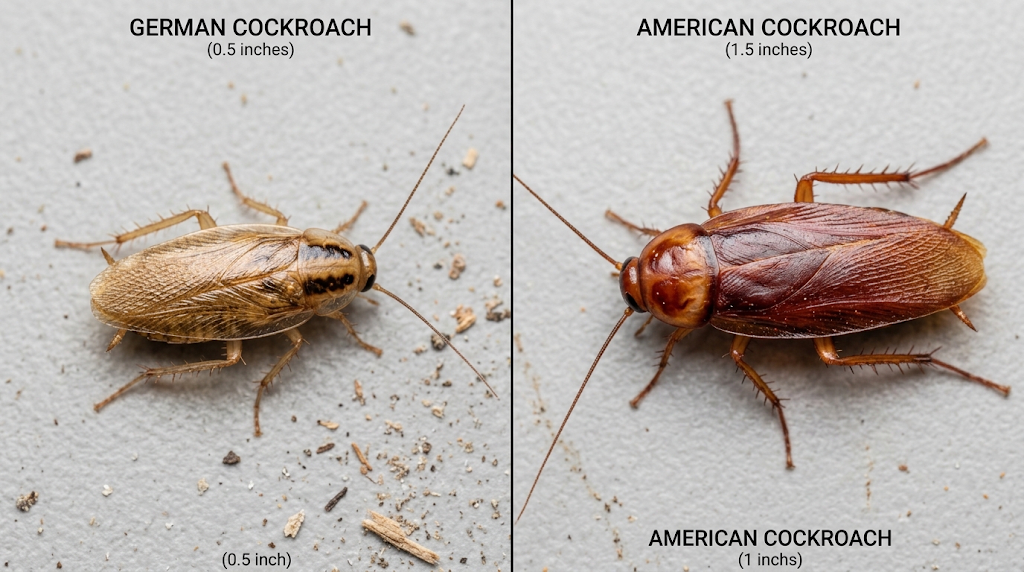
For anyone with a fear of insects, encountering a standard half-inch German cockroach on the kitchen floor is enough to cause a panic. But far beyond the confines of urban baseboards and kitchen cabinets, hidden deep within tropical rainforests and subterranean burrows, cockroaches grow to truly monumental proportions.
Far from the dirty pests associated with human dwellings, these exotic giants are gentle, fascinating marvels of evolution. They play essential roles in global ecosystems as master recyclers, turning forest debris into nutrient-rich soil.
Quick Comparison: The World’s Largest Cockroach Species
| Species | Common Name | Native Region | Defining Record | Primary Habitat |
| Megaloblatta longipennis | — | Central & South America | Largest Wingspan (Up to 8 inches) | Rainforest canopy |
| Macropanesthia rhinoceros | Giant Burrowing Cockroach | Queensland, Australia | Heaviest (Up to 35 grams) | Subterranean soil burrows |
| Blaberus giganteus | Giant Cave Cockroach | Central & South America | Longest Body (Up to 4 inches) | Caves & hollow tree trunks |
| Archimandrita tesselata | Peppered Cockroach | Central America | Broadest Wing Shield (Up to 3.5 inches) | Tropical leaf litter |
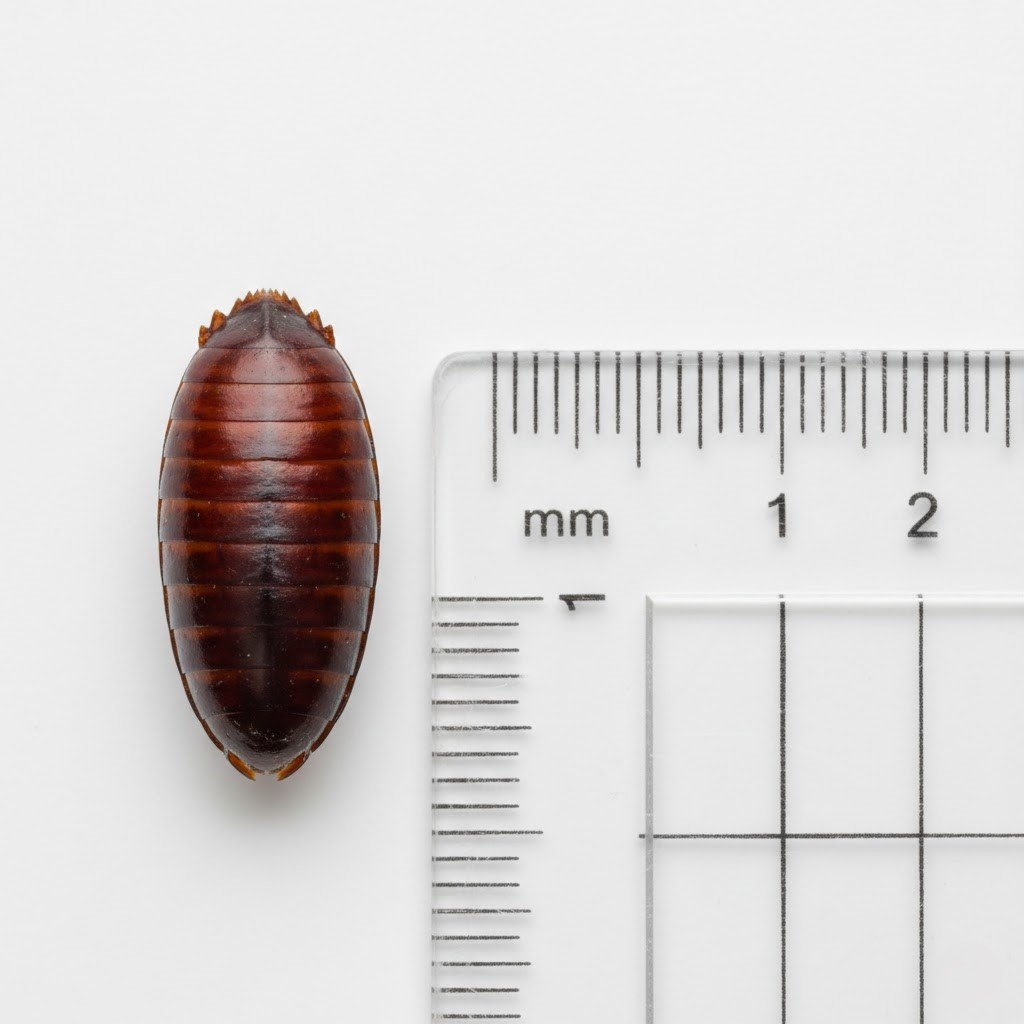
1. Megaloblatta longipennis – The Wingspan Champion
If you measure insect size by pure aerial presence, Megaloblatta longipennis takes the undisputed world crown.
Native to the humid rainforest canopies of Peru, Ecuador, and Panama, this rare species boasts a wingspan that can stretch up to 8 inches (20 cm) across, with a body length approaching 3.8 inches (9.7 cm).
- Canopy Specialists: Unlike the subterranean creepers most people imagine, M. longipennis spends its life high up in the tropical canopy, navigating between mossy tree trunks and epiphytes.
- Master Flyers: While standard domestic roaches are clumsy gliders at best, Megaloblatta has powerful, fully developed forewings (tegmina) that allow it to navigate through the dense forest canopy.
- No Pest Risk: This species requires strict tropical humidity and specialised forest diets; it cannot survive in dry human homes.
2. Macropanesthia rhinoceros – The Heavyweight Champion
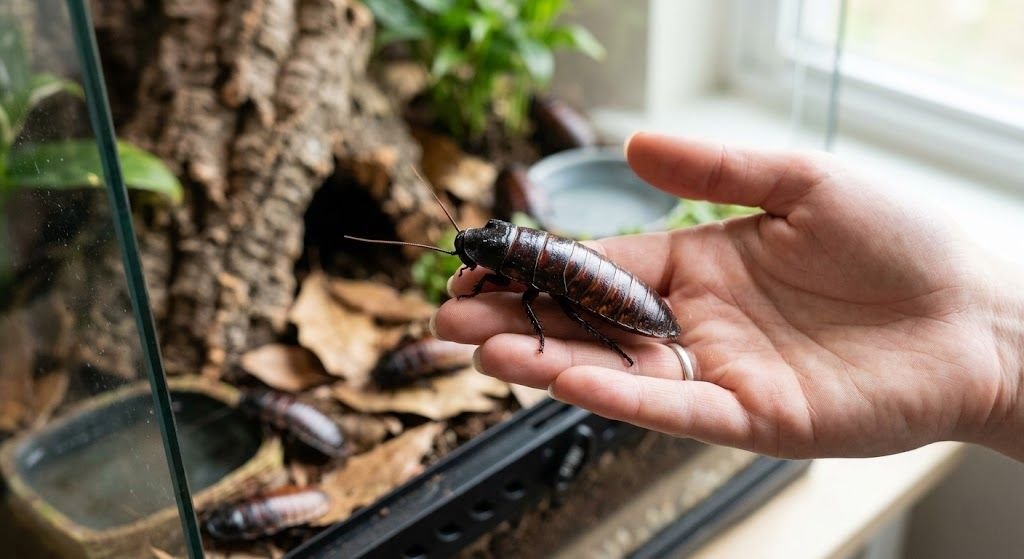
When it comes to sheer mass, bulk, and raw strength, the Australian Giant Burrowing Cockroach (Macropanesthia rhinoceros), also known as the Rhinoceros Cockroach, has no equal.
Native to the dry, tropical scrublands of Queensland, Australia, these colossal insects can tip the scales at over 30 to 35 grams (over 1.2 oz)—roughly the weight of a golf ball—and grow up to 3.1 inches (8 cm) in length.
- Living Bulldozers: These insects look far more like heavy-duty armoured beetles than typical cockroaches. They are completely wingless and possess modified, shovel-like spiny legs engineered for moving heavy earth.
- Subterranean Architecture: They dig intricate, permanent burrows up to 3 feet (1 metre) deep into the soil, dragging dry eucalyptus leaves underground to ferment and consume.
- Remarkable Lifespan: Unlike common domestic pests that live for a matter of months, the rhinoceros cockroach can live for up to 10 years, making it a beloved, low-maintenance exotic pet in Australia and among entomologists worldwide.
3. Blaberus giganteus – The Cave-Dwelling Giant
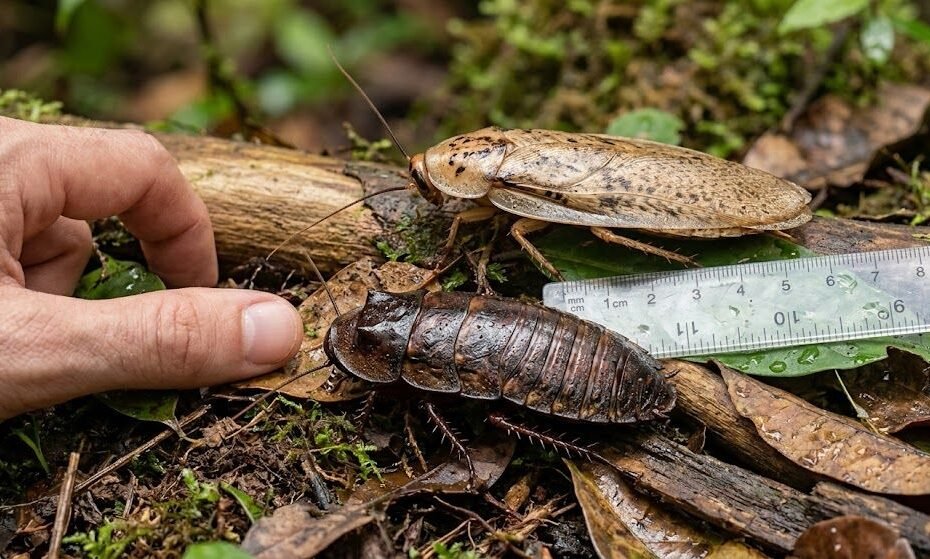
Also known as the Central American Giant Cave Cockroach, this species is frequently cited as one of the longest insects in the Blattodea order, with mature females routinely measuring 3.5 to 4 inches (9 to 10 cm) in overall length.
- Appearance: They sport broad, translucent, parchment-coloured wings offset by a dramatic, dark, shield-like marking on their pronotum that resembles a silhouette of a bat.
- Cave Ecosystem Anchors: Found throughout the rainforests of Mexico, Central America, and northern South America, they congregate in warm, pitch-black limestone caves and rotting hollow logs.
- Dietary Cleanup Crew: They act as primary scavengers, feeding voraciously on massive piles of bat guano, fallen fruit, and decaying animal matter, recycling nutrients that sustain entire cave ecosystems.
4. Archimandrita tesselata – The Giant Peppered Cockroach
Another heavyweight contender from the tropical forests of Costa Rica, Guatemala, and Panama is the Peppered Cockroach (Archimandrita tesselata).
- Stout and Armoured: Reaching lengths between 3 and 3.5 inches, these roaches are known for their wide, flattened bodies and speckled, pepper-like camouflage patterns that blend seamlessly into rotting bark.
- Defensive Strategy: When threatened, they flatten themselves against tree bark and emit a faint, musky warning odour rather than fleeing, relying on their heavy carapace for defence.
Why Giant Cockroaches Matter to the Planet
Out of more than 4,500 species of cockroaches identified worldwide, fewer than 1% (around 30 species) are considered household pests.
The vast majority—especially the giants—are vital ecological engineers:
- Nutrient Cycling: Giant forest roaches break down tough, fibrous plant cellulose, leaf litter, and wood, returning essential nitrogen and organic carbon to the forest floor.
- Soil Aeration: Burrowing species churn up compacted earth, aerating the soil and allowing rainwater to penetrate deep root systems.
- Food Web Foundation: In their native habitats, they serve as a critical, protein-packed food source for birds, reptiles, amphibians, and small mammals.
Conclusion: Gentle Giants of the Natural World
While the idea of an eight-inch wingspan or a golf-ball-sized cockroach might sound like fuel for nightmares, these exotic giants are a testament to nature’s evolutionary creativity. They do not carry household pathogens, they do not infest pantries, and they have zero interest in invading human homes.
Instead, they remain quietly tucked away in remote rainforest canopies, underground Australian burrows, and tropical caves—working diligently as nature’s clean-up crew and reminding us that the insect world is far more diverse and beneficial than the few pests we find in our kitchens.
Frequently Asked Questions (FAQ)
1. What is the single heaviest cockroach in the world?
The heaviest cockroach in the world is the Australian Giant Burrowing Cockroach (Macropanesthia rhinoceros). Adult specimens can weigh over 35 grams (1.2 oz) and measure up to 3.1 inches in length, possessing a dense, heavy exoskeleton built for digging.
2. Can giant exotic cockroaches infest my home or apartment?
No. Giant exotic cockroaches cannot survive in the low-humidity, temperature-controlled environment of a modern home. They have highly specialised diets (such as decaying eucalyptus leaves, bat guano, or tropical canopy detritus) and require sustained high humidity levels (70–90%) to moult and survive.
3. Do giant cockroaches bite or sting humans?
No. Giant cockroaches do not possess stingers, venom glands, or aggressive predatory instincts. Their mouthparts are designed strictly for chewing soft, decomposing organic matter. While their spiny legs can feel prickly or scratchy if they crawl across your skin, they are entirely harmless and docile.
4. Can the Megaloblatta longipennis actually fly?
Yes. Unlike domestic pest roaches that merely glide or flutter when dropping from high places, Megaloblatta longipennis has strong, fully developed wings with an 8-inch wingspan capable of sustained, controlled flight through tropical rainforest canopies.
5. Why do people keep giant burrowing cockroaches as pets?
Giant Burrowing Cockroaches make popular exotic pets because they are clean, odourless, completely wingless, and cannot climb smooth glass or plastic surfaces. Furthermore, they are docile to handle, live for up to 10 years, and survive simply on fallen leaves and occasional fruit scraps.
6. How does the lifespan of a wild giant cockroach compare to a domestic pest?
Common domestic pests like the German cockroach live for approximately 5 to 7 months. In contrast, giant species have slow metabolisms and lengthy maturation cycles; for example, the giant burrowing cockroach takes up to 3 years just to reach adulthood and can live up to 10 years in total.
7. What do giant cockroaches eat in the wild?
In nature, giant cockroaches are primary detritivores. Depending on the species, their diet consists of fallen eucalyptus leaves, rotting hardwoods, bat guano, forest leaf litter, decaying fruits, and decomposing plant matter.