Learn how to tell German and American cockroaches apart by comparing physical size, distinctive markings, hiding spots, flight abilities, and breeding rates.
If you spot a cockroach darting across the floorboards late at night, your initial reaction is likely shock and frustration. Once the adrenaline settles, however, the most important step you can take is accurate identification.
Not all cockroaches are created equal. The two most common home-invading species are the German cockroach (Blattella germanica) and the American cockroach (Periplaneta americana). While both are unwelcome pests, they possess radically different behaviours, preferred habitats, reproductive timelines, and treatment vulnerabilities.
Treating an American cockroach problem with German cockroach tactics (or vice versa) is one of the main reasons DIY pest control efforts fail.
Quick Comparison: German vs. American Cockroach
| Feature | German Cockroach (Blattella germanica) | American Cockroach (Periplaneta americana) |
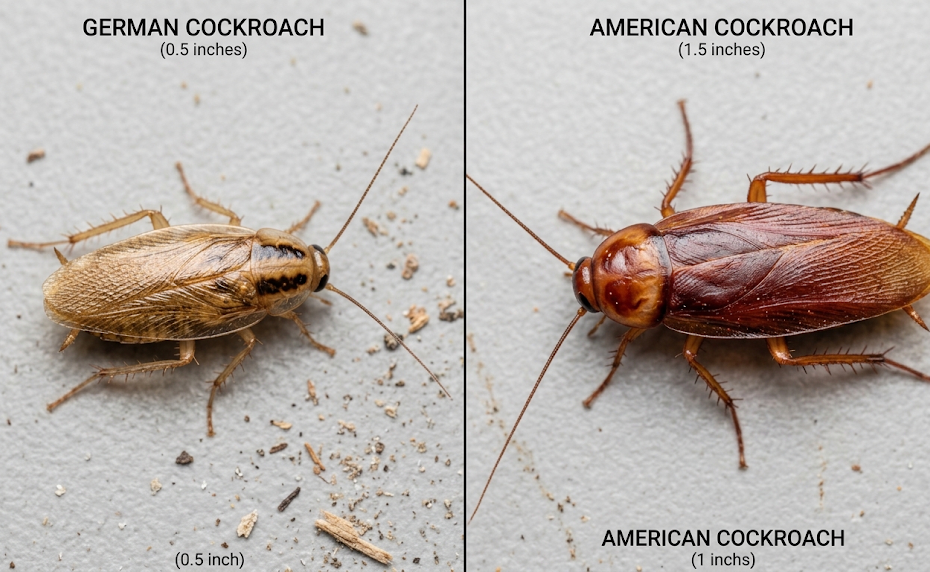
| Adult Size | 0.5 to 0.6 inches (13–16 mm) | 1.5 to 2.1 inches (38–53 mm) |
| Colouration | Light brown to tan | Glossy reddish-brown to dark mahogany |
| Pronotum Markings | 2 dark parallel vertical stripes (“racing stripes”) | Pale yellowish “figure-8” pattern or ring |
| Flight Ability | Possesses wings but cannot sustain flight (runs/flutters) | Fully capable of gliding and clumsy flight from heights |
| Primary Habitat | Strictly indoors (kitchens, bathrooms, appliances) | Peridomestic/Outdoors (sewers, basements, mulch, drains) |
| Eggs per Capsule | 30 to 40 eggs per capsule | 14 to 16 eggs per capsule |
| Egg Care | The female carries the egg case until hours before hatching. | Female drops/glues egg case in safe crevice within 24 h. |
| Maturation Time | Rapid: 50 to 60 days from egg to adult | Slow: 6 to 12+ months from egg to adult |
1. Physical Appearance: The Visual Breakdown
The quickest way to differentiate these two species is through simple visual cues: size, colour, and pronotum markings.
The German Cockroach
- Size: Compact and small, rarely exceeding half an inch to 5/8 of an inch in length.
- Colour: Light caramel brown or tan with a non-glossy finish.
- The “Racing Stripes”: The single most reliable identifier is located on the pronotum (the plate directly behind the head). German roaches feature two distinct, dark brown or black parallel stripes running vertically toward their wings.
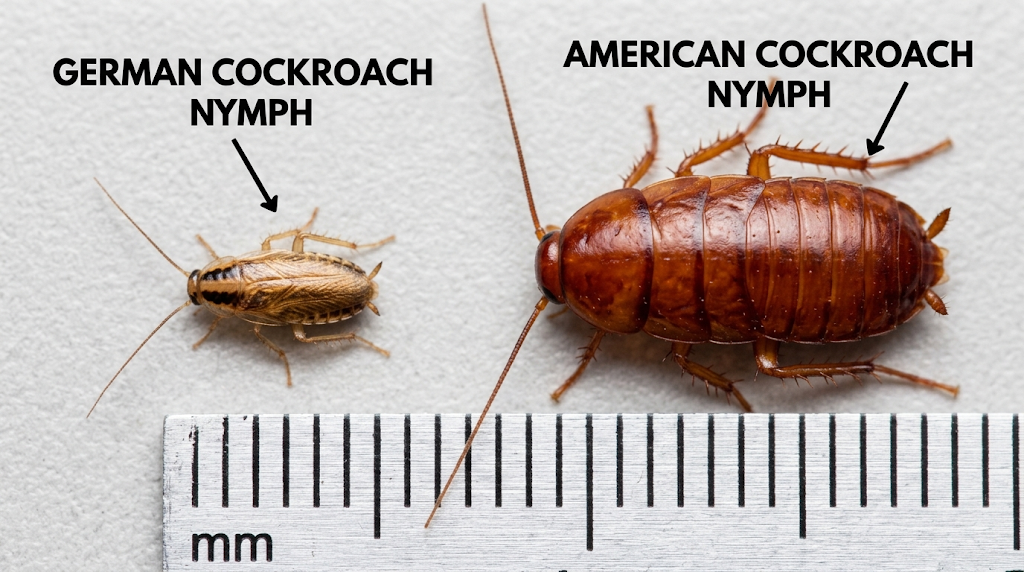
- Nymphs (Juveniles): Nymphs are tiny (the size of a pinhead when newly hatched), dark brown, and have a light stripe running down the centre of their backs.
The American Cockroach
- Size: The largest home-invading species, often reaching 1.5 to over 2 inches in length.
- Colour: Shiny, glossy reddish-brown or mahogany.
- The “Figure-8” Halo: The pronotum features a distinct yellow or tan outer margin that forms a pattern resembling a yellow halo or figure-eight surrounding a dark central patch.
- Nymphs (Juveniles): American roach nymphs emerge uniformly grey-brown, gradually turning reddish-brown as they moult through several developmental instars.
2. Flight Capabilities: Gliders vs. Sprinters
Both species possess fully developed wings as adults, but they use them in very different ways:
- German Cockroaches: Despite having functional wings, German cockroaches almost never fly. If dropped from a high surface, they may flutter or glide awkwardly to break their fall, but they rely 100% on their rapid running speed to escape danger.
- American Cockroaches: American roaches are capable of gliding flight, particularly in warm temperatures (above 85°F / 29°C). They frequently launch themselves from trees, roofs, or high walls to glide down onto patios, balconies, or open windows.
3. Habitat and Harbourages: Where Are They Living?
Understanding where you encounter the insect provides major clues to its identity:
German Cockroaches (Indoor Obligates)
German cockroaches cannot survive long-term outdoors in temperate climates. They are strict domestic pests that rely entirely on human structures for warmth, food, and moisture:
- Tightly wedged inside cabinet door hinges and drawer glides.
- Clustered inside the warm motor compartments of refrigerators, dishwashers, and microwaves.
- Living inside wall outlets, electrical switch boxes, and beneath sink rims.
American Cockroaches (Peridomestic Invaders)
American cockroaches are primarily outdoor scavengers that prefer damp, dark, decaying environments:
- City sewer mains, storm drains, and municipal water meter boxes.
- Damp basements, crawl spaces, boiler rooms, and sump pump pits.
- Outdoor landscaping features like pine straw, decaying mulch beds, compost piles, and hollow tree bark.
- They generally enter living areas by accident—crawling up dry plumbing traps, slipping under exterior door sweeps, or seeking shelter during heat waves and heavy rains.
4. Reproductive Speed and Infestation Severity
The reproductive disparity between these two species explains why German roaches are considered one of the most stubborn indoor pests on the planet.
American Cockroach (Slow, Steady Growth): A female American roach produces an egg capsule containing 14 to 16 eggs. She carries the capsule for only 24 to 48 hours before cementing or dropping it in a hidden crevice. The eggs incubate unprotected for 6 to 8 weeks, and nymphs require 6 to 12 months (or longer) to mature into reproductive adults.
German Cockroach (Explosive Growth): A single female German cockroach produces an egg capsule (ootheca) containing 30 to 40 eggs. Crucially, she carries this capsule attached to her abdomen for roughly 28 days, releasing it only hours before the nymphs emerge. This maternal protection shields the eggs from pesticides, predators, and desiccation. With a lifecycle of just two months, a single pair can trigger a population explosion of thousands within six months.
5. Control and Treatment Strategies
Because their behaviours differ, elimination requires two distinct game plans:
Treating German Cockroaches
- Targeted Gel Baits: Apply small, pea-sized dots of slow-acting roach bait (Indoxacarb, Fipronil) near cabinet hinges, under countertops, and behind appliances.
- Insect Growth Regulators (IGRs): Use IGRs (Pyriproxyfen, Hydroprene) to interrupt the hormonal development of nymphs, sterilising the breeding population.
- Avoid Repellent Sprays: Never use over-the-counter aerosol bug bombs or repellent baseboard sprays; they cause German roach colonies to scatter into bedrooms and adjoining walls.
Treating American Cockroaches
- Exclusion and Sealing: Install tight door sweeps on exterior doors, seal gaps around plumbing penetrations with silicone caulk or copper mesh, and cover outdoor weep holes.
- Maintain Plumbing Traps: Pour water down rarely used basement or guest bathroom floor drains to ensure the P-traps stay full, preventing roaches from climbing up from municipal sewer lines.
- Perimeter Treatments: Apply weather-resistant granular baits or residual barrier sprays around the exterior foundation, flowerbeds, and crawl space entryways.
Conclusion: Correct Identification Leads to Faster Elimination
Determining whether you are facing German or American cockroaches is the critical first step in reclaiming your home.
If you are dealing with American cockroaches, your battle is primarily about exclusion—sealing perimeter gaps, adding drain covers, and clearing damp mulch away from the foundation.
If you have German cockroaches, you are facing an active indoor infestation that demands an immediate, meticulous regimen of gel baits, growth regulators, and pristine sanitation. Knowing the difference saves you time, cuts down on unnecessary chemical use, and ensures you wipe out the colony at its source.
Frequently Asked Questions (FAQ)
1. Are American cockroaches the same thing as “palmetto bugs” or “waterbugs”?
Yes. In many southern and coastal regions of the United States, American cockroaches are colloquially referred to as “palmetto bugs” or “waterbugs”. Despite the friendlier nicknames, they are true cockroaches (Periplaneta americana).
2. Can German and American cockroaches crossbreed?
No. German and American cockroaches belong to completely different taxonomic genera (Blattella vs. Periplaneta). They are genetically incompatible and cannot mate, crossbreed, or produce hybrid offspring.
3. If I find a single American cockroach in my house, do I have an infestation?
Not necessarily. American roaches frequently wander inside as isolated “invaders” looking for moisture or escaping heavy rain and heat. Finding one American roach often means an exterior door seal or drain was left open, whereas finding even a single German roach indoors almost always indicates an established, breeding population nearby.
4. Which species poses a greater threat to human health?
While both species spread bacteria (including Salmonella and E. coli), German cockroaches pose a significantly higher health threat indoors. Because they nest in high concentrations inside kitchens, food pantries, and food prep areas, their accumulated faeces, saliva, and cast skins are major indoor allergy triggers and a leading cause of childhood asthma flare-ups.
5. Why shouldn’t I use bug bombs (foggers) for German roaches?
Total-release foggers fill the centre of a room with repellent mist that settles onto open surfaces without penetrating the tight cracks, appliances, and wall voids where German roaches actually hide. The chemical irritation triggers the “scattering effect”, causing the colony to disperse into bedrooms, living rooms, and adjacent units.
6. How do German cockroaches get into a home in the first place?
Unlike American roaches that crawl in from the yard or sewer, German roaches are transported hitchhikers. They enter homes with used appliances (microwaves, fridges), second-hand furniture, grocery delivery bags, cardboard moving boxes, or luggage brought home from an infested location.
7. Do American cockroaches bite humans?
American cockroaches rarely bite humans. In extreme, rare cases of severe food deprivation within massive infestations, they may nibble on eyelashes, fingernails, or skin flakes of sleeping individuals, but they do not possess venom or predatory biting behaviour.