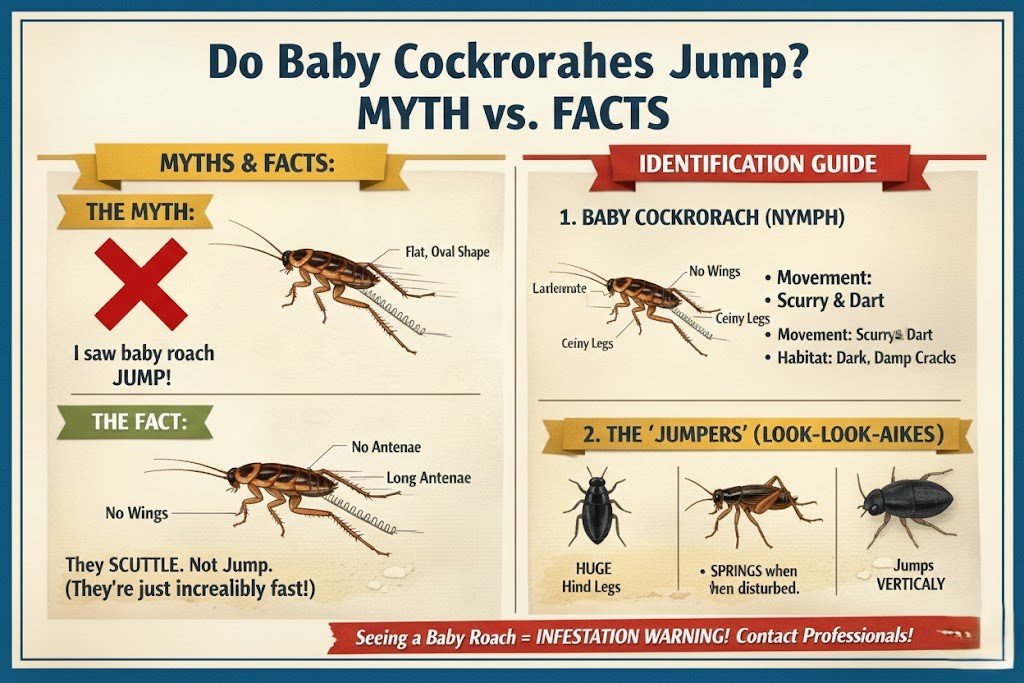
The Jumping Myth: Can Baby Roaches Catch Air?
Locomotion – The various biological methods and mechanical actions that an organism uses to move from one place to another.
If you have ever gone to squash a bug only to have it suddenly leap several feet into the air, your heart likely skipped a beat. However, if you thought you just witnessed a jumping baby cockroach, you are mistaken. Cockroaches, regardless of age or species, cannot jump. Their anatomy simply does not allow for it.
How Cockroaches Actually Move: Scurrying, Gliding, and Climbing
Tarsi – The final segments of an insect’s leg, functioning similarly to feet, often equipped with tiny claws and adhesive pads for gripping surfaces.
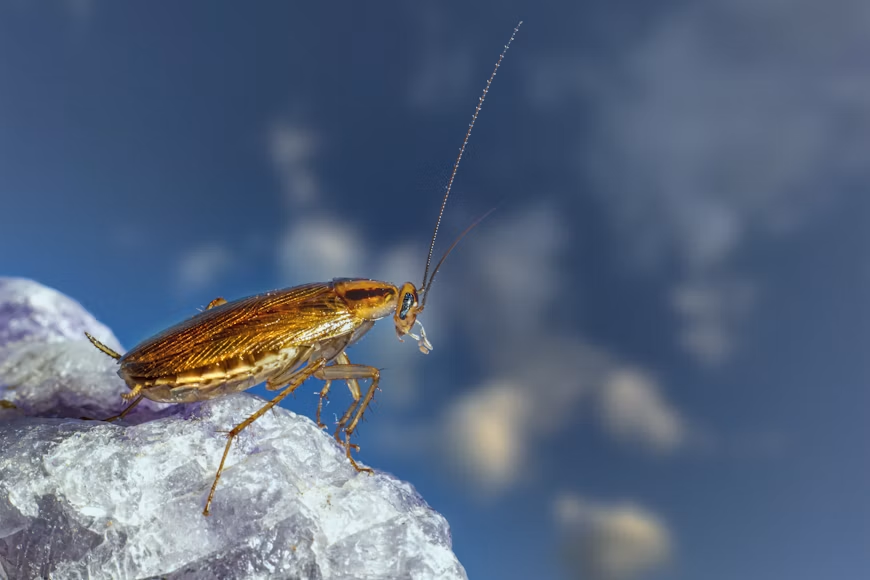
Cockroaches are built for incredible, flat-out ground speed. Their six legs are designed to rapidly propel their aerodynamic bodies across floors and up vertical walls. Thanks to the specialized pads on their tarsi, they can effortlessly scale smooth surfaces like glass and ceilings. While some adult roaches can use their wings to glide or fly to escape danger, baby roaches (nymphs) do not have developed wings. If a bug is leaping off the ground, it is definitively 100% not a cockroach.
Mistaken Identity: Common Jumping Bugs That Look Like Baby Roaches
If you have small, brown insects launching themselves around your home, you have simply misidentified the pest. Due to their coloration and size, there are a few common household invaders that are frequently mistaken for cockroach nymphs. Knowing the difference is crucial for effective extermination.
Flea vs. Baby Roach: How to Tell the Difference
Flea – A small, wingless, jumping parasitic insect that feeds exclusively on the blood of mammals and birds.
Fleas are notoriously incredible jumpers, capable of leaping vertically up to 7 inches. If the bug is tiny, dark reddish-brown, and jumping aggressively around your ankles or your pets, it is a flea. Unlike the wide, flat body of a roach nymph, a flea’s body is laterally compressed (very thin from side to side), allowing it to easily navigate through animal fur.
Cricket vs. Baby Roach: Identifying the Spring-Legged Pests
Camel crickets and field crickets are frequently mistaken for cockroaches when they hide in dark basements or garages. Crickets are brown or black and share a similar size profile. However, crickets have massively enlarged, muscular hind legs specifically evolved for jumping. If the bug has giant back legs folded like springs, you are dealing with a cricket, not a roach.
Action Plan: What to Do Once You’ve Correctly Identified the Culprit
If you determine the jumping bug is a flea, you must immediately treat your pets with veterinarian-approved flea medication and heavily vacuum all carpets and upholstery in your home. If it is a cricket, reducing moisture with a dehumidifier and sealing gaps under doors will easily solve the problem. Proper identification ensures you do not waste time and money treating the wrong pest!
FAQ Section
1. Do baby cockroaches jump when you try to hit them?
No, they don’t jump. They use a rapid “scurry” maneuver. Their escape reflex is incredibly fast, and they can move in a new direction in milliseconds, which can look like a hop or a jump if they are moving from a surface to the floor.
2. Are there any roach species that actually jump?
There is only one known species, the Leaproach (Saltablattella montistabularis), discovered in South Africa, which has legs modified for jumping. However, this species is not a household pest and is not found in North America or Europe. Household roaches like the German, American, or Oriental varieties cannot jump.
3. How small are baby cockroaches when they first hatch?
They are roughly the size of a pinhead or a grain of pepper (about 3mm). Because of their size and dark color, they are often mistaken for dirt or small beetles.
4. Can baby roaches climb smooth surfaces?
Yes. Most common baby roaches have specialized pads on their feet (arolia) that allow them to climb smooth glass, plastic, and polished metal. This is why you may find them inside “sealed” Tupperware or climbing up mirrors.
5. Why do I see baby roaches but no adults?
Adult roaches are much more cautious and stay deeper in the walls. Nymphs are less experienced and often have to venture out further or at “wrong” times to find food if the adult population has already claimed the best spots.
6. If an insect jumps on me, is it a cockroach?
It is highly unlikely. If an insect jumps onto you, it is much more likely to be a cricket, a grasshopper, or a flea. Cockroaches generally try to move away from humans as fast as possible.
Read More Guide: How Big Are Baby Cockroaches? Identification and Prevention Guide
Conclusion
To summarize, do baby cockroaches jump? No, they lack the biological “spring” legs required for jumping. What you are seeing is a combination of lightning-fast running and gravity-defying climbing skills. Knowing how small are baby cockroaches—often no larger than a peppercorn—helps you realize just how easily they can hide in your home.
If you see a tiny, dark insect that runs rather than jumps, you are likely looking at a cockroach nymph. This discovery should be met with immediate action. By sealing cracks, using IGRs, and maintaining a dry, clean environment, you can stop the infestation before these tiny nymphs grow into a massive problem.
Next Steps for Homeowners:
- Check under your sink for moisture or leaks.
- Seal dry food in airtight containers to remove the nymphs’ food source.
- If you see more than two nymphs in a week, contact a professional to locate the nest.
Identifying the problem is half the battle. Now that you know what you’re looking at, you can take the necessary steps to protect your home.


