Discover the science behind Insect Growth Regulators (IGRs), the professional-grade solution that acts as birth control for cockroaches. Learn how this secret weapon breaks the breeding cycle and permanently ends infestations.
The Endless Cycle of Frustration
If you have ever battled a severe cockroach infestation, you know the devastating cycle: you spray, the bugs disappear for a week, and then suddenly, hundreds of tiny baby roaches (nymphs) emerge from the walls to start the nightmare all over again. Traditional insecticides are great at killing the adult bugs you see, but they do nothing to stop the eggs that are already hidden.
When professional exterminators are called to handle a massive infestation, they don’t just rely on poisons. They bring out the heavy artillery: Insect Growth Regulators (IGRs). This is the secret weapon that separates permanent eradication from temporary relief.
What is an Insect Growth Regulator (IGR)?
Definition: Insect Growth Regulator (IGR)
A synthetic chemical compound that mimics natural insect hormones, disrupting their biological development and preventing them from reaching sexual maturity.
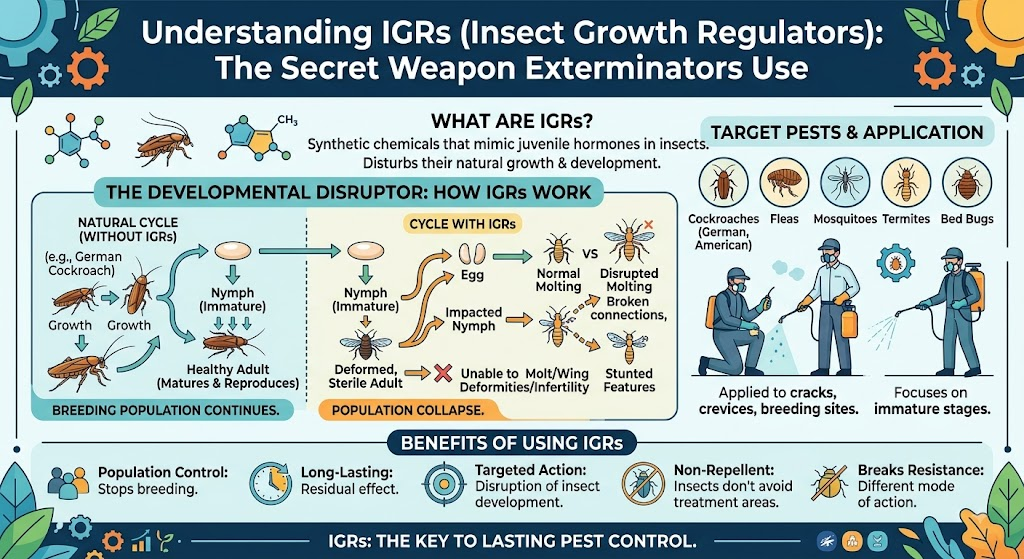
Unlike traditional pesticides (adulticides), which are designed to attack a cockroach’s nervous system and kill it on contact or through ingestion, an IGR is not meant to be a lethal poison. Instead, it alters the insect’s DNA expression during its growth phases. When a cockroach is exposed to an IGR, the chemical scrambles the biological signals required for them to develop properly.
How IGRs Break the Cockroach Life Cycle
Cockroaches grow by molting—shedding their hard outer exoskeleton to accommodate a larger body. This process is highly regulated by juvenile hormones. IGRs essentially flood the insect’s system with fake juvenile hormones.
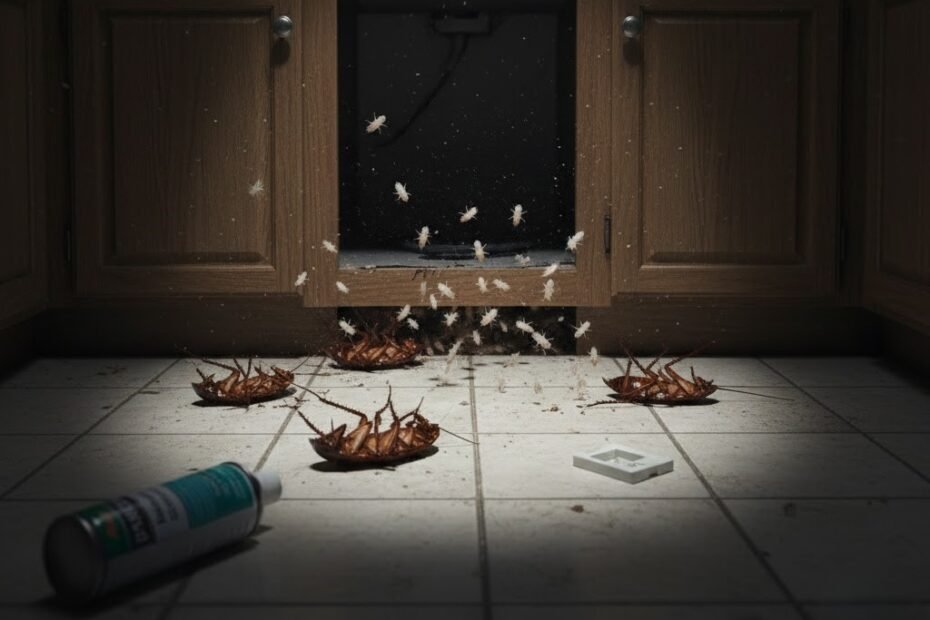
When a cockroach nymph (baby roach) exposed to an IGR attempts to molt, the process fails catastrophically. The insect becomes physically deformed. Their wings may grow in twisted and crumpled, their exoskeletons may fail to harden, and most importantly, their reproductive organs never fully develop.
The “Birth Control” for Bugs

The most powerful aspect of an IGR is that it renders the exposed cockroach entirely sterile. Even if the deformed cockroach survives into adulthood, it cannot reproduce.
Cockroaches rely on exponential population growth to survive. A single female can produce thousands of descendants in a single year. By turning the developing nymphs sterile, an IGR acts as permanent birth control for the nest. Once the current generation of adults dies off from old age or traditional baits, there is no new generation to replace them. The colony’s population graph flatlines, and the infestation collapses.
Why Exterminators Always Use a Combo-Approach
You might be wondering: if IGRs don’t immediately kill the adult roaches, why are they so effective? The secret is in the combination.
Exterminators never use an IGR entirely on its own. They use a one-two punch:
- The Knockdown (Adulticide/Baits): This instantly kills the adult, foraging cockroaches that are currently causing problems in your kitchen.
- The Safety Net (IGR): This ensures that any hidden egg cases that hatch weeks later will only produce sterile nymphs that can never lay eggs of their own.
How to Use IGRs in Your Own Home
Fortunately, this professional-grade secret is now available to consumers. Homeowners can purchase IGRs in a few different formats:
- Aerosol Sprays: Products like Gentrol can be sprayed along baseboards and under sinks. The chemical compound is heavy and settles deep into cracks and crevices where nymphs hide.
- Point-Source Stations: These look like small plastic discs. You crack a vial inside, and the IGR slowly evaporates into the air, permeating a 75-square-foot area. These are incredibly easy to stick behind a refrigerator or inside a pantry.
- Liquid Concentrates: For severe infestations, liquid concentrates can be mixed with water and applied with a pump sprayer.
If you are dealing with German cockroaches—the most notoriously difficult indoor pest to conquer—adding an IGR to your baiting and cleaning routine is the absolute best way to guarantee they never come back.
Conclusion
Seeing baby roaches after an extermination is a standard part of the pest control timeline. Between the flush-out effect, the resilience of egg cases, and the slow-but-steady work of Insect Growth Regulators, your home is currently a battlefield.
The key takeaways are simple: stay consistent with sanitation, avoid using DIY sprays that interfere with professional products, and keep a close eye on the “health” of the roaches you see. If they look sluggish or deformed, victory is near.
Stay the course, follow the expert recommendations, and soon your home will be the sanctuary it was meant to be.
FAQ
1. Does seeing baby cockroaches mean the spray didn’t work?
No. Usually, it means the spray worked on the adults, but the eggs (which are protected from chemicals) have recently hatched. These new nymphs will die once they come into contact with the dried residual treatment.
2. How long does it take for baby roaches to die after professional treatment?
Typically, you will see a significant decline within 7 to 14 days. However, because of the hatching cycle, it can take up to 30 days to break the entire population chain.
3. Should I spray store-bought Raid if I see a baby roach?
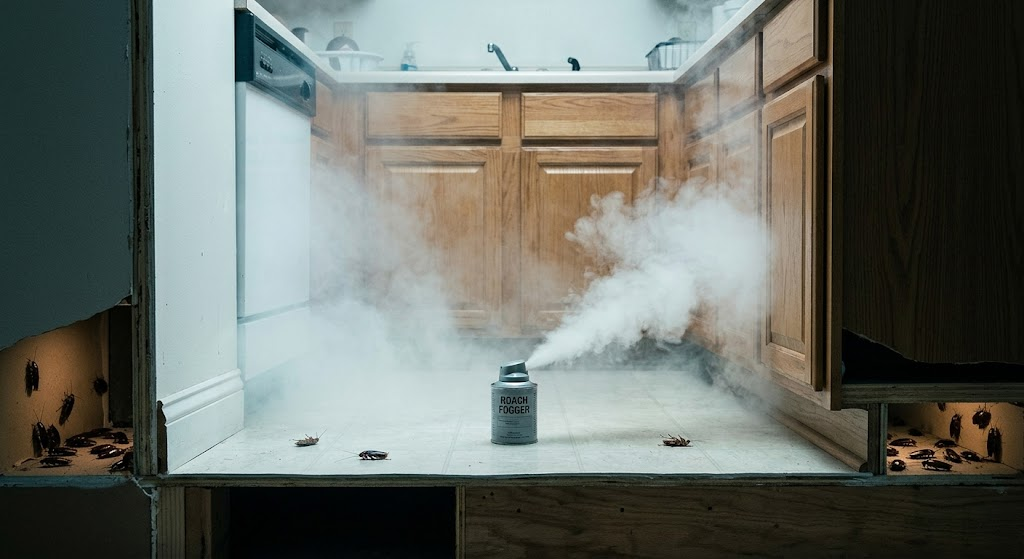
No. Using over-the-counter sprays can actually interfere with professional-grade residuals or baits. Most “bug bombs” or cheap sprays act as repellents, which may scatter the roaches further into the walls, making the professional’s job harder.
4. Why am I seeing more roaches now than before the treatment?
This is the “flush-out” effect. The chemicals are irritating the roaches and driving them out of their hiding spots. Seeing more roaches immediately after treatment is often a sign of success, not failure.
5. Can baby roaches live in my electronic devices?
Yes. Roaches are attracted to the warmth of motor housings in refrigerators, microwaves, and even gaming consoles. If you see nymphs near electronics, inform your exterminator so they can use specialized baits in those areas.